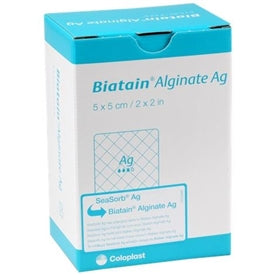
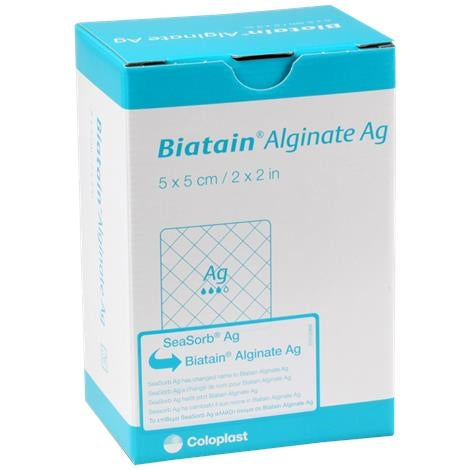


Coloplast Biatain Alginate Ag Silver Dressing — 85% Alginate/15% CMC, 18× Absorption,
/


Coloplast Biatain Alginate Ag Silver Dressing — 85% Alginate/15% CMC, 18× Absorption, 7-Day Silver, 4 Sizes
85% calcium alginate. 15% CMC. Patented ionic silver complex. Absorbs 18 times its own weight. Continuous antimicrobial effect for up to 7 days. Documented hemostatic effect — unlike hydrofiber dressings. Converts to a cohesive gel that locks exudate in and removes in one piece. Coloplast Biatain Alginate Ag (formerly SeaSorb Ag) is a sterile, highly absorbent silver alginate primary wound dressing for moderately to heavily exuding infected wounds and wounds at risk of infection. Its unique three-component composition — 85% calcium alginate, 15% carboxymethylcellulose (CMC), and Coloplast's patented ionic silver complex — creates a dressing that simultaneously manages high-volume exudate, delivers continuous broad-spectrum antimicrobial protection, and maintains the high-integrity gel structure needed for clean, one-piece removal at dressing change. The 15% CMC content is the structural feature that differentiates Biatain Alginate Ag from standard calcium alginate dressings: CMC reinforces the gel matrix as the alginate converts, giving the dressing its exceptional wet strength, its 18× absorption capacity, and its ability to hold integrity and remove cleanly even when fully saturated — a combination standard alginate dressings without CMC cannot reliably deliver. Available in four sizes including a 1" × 17½" rope for cavity and tunneling wounds. Compatible with compression bandaging.
✔ 85% Calcium Alginate / 15% CMC — CMC-Reinforced High-Integrity Gel ✔ 18× Absorption — Locks Exudate, Prevents Maceration ✔ Patented Ionic Silver Complex — Continuous 7-Day Antimicrobial Effect ✔ Documented Hemostatic Effect — Unlike Hydrofiber Dressings ✔ One-Piece Removal — High Wet Strength Throughout Wear ✔ Cut to Shape — Conforms to Any Wound Size, Shape & Depth ✔ Compression Compatible — 4 Sizes Including Rope
Product Details & Available Sizes
| Manufacturer | Coloplast |
|---|---|
| Formerly Known As | SeaSorb Ag (same product, rebranded to Biatain Alginate Ag) |
| Composition | 85% calcium alginate / 15% carboxymethylcellulose (CMC) / patented ionic silver complex |
| Absorption | Up to 18× the dressing's own weight in wound exudate |
| Silver | Patented ionic silver complex — releases ions in presence of wound exudate; continuous effect throughout wear period |
| Antimicrobial Duration | Up to 7 days continuous antimicrobial effect |
| Gel Formation | Converts to soft, cohesive gel on contact with exudate — conforms to wound bed; locks exudate inside gel |
| Wet Strength | High — dressing maintains structural integrity when saturated; one-piece removal with minimal residue |
| Hemostatic Effect | Documented — arrests blood flow in minor bleedings; unlike hydrofiber dressings which do not have this effect |
| Exudate Level | Moderate to heavy — not for dry or lightly exuding wounds |
| Secondary Dressing | Required — to hold in place and manage moisture; non-occlusive or semi-occlusive secondary appropriate |
| Cut to Size | Yes — may be cut to any size or shape while retaining all properties |
| Compression Compatible | Yes — suitable for use under compression bandaging |
| HCPCS Code | A6196 (pad); A6199 (rope) |
| Sterility | Sterile |
| 3755 | 2" x 2" Pad — Box of 10 |
| 3760 | 4" x 4" Pad — Box of 10 |
| 3765 | 6" x 6" Pad — Box of 10 |
| 3780 | 1" x 17½" Rope — Box of 10 |
Indicated For — Wound Types
- Infected wounds — use as part of a clinical treatment protocol
- Wounds at risk of infection — elevated bioburden, clinical signs of local infection
- Leg ulcers — venous, arterial, mixed etiology
- Pressure ulcers / pressure injuries — all stages with moderate-to-heavy exudate
- Diabetic foot ulcers
- Donor sites
- Traumatic wounds
- Second degree (partial thickness) burns
- Sloughy wounds requiring absorption and autolytic debridement support
- Cavity wounds and tunneling wounds — use 1" × 17½" rope
- Wounds under compression bandaging
Contraindications: Not for dry or lightly exuding wounds — insufficient exudate to activate gel formation can cause dressing adherence. Not for controlling heavy bleeding. Not for patients with known sensitivity to silver or alginate components. Not for third-degree burns.
The Three-Component Formula — Why 85/15 Alginate/CMC Matters
Standard calcium alginate dressings are composed exclusively or primarily of calcium alginate fibers. When calcium alginate contacts wound exudate, the sodium ions in the wound fluid displace the calcium ions in the fiber structure — the fiber undergoes an ion exchange that converts it from a solid fiber to a soft gel. This gel formation is the core function of all alginate dressings: it creates a moist wound healing environment, absorbs exudate, and provides the familiar non-adherent wound contact layer that makes alginates preferable to gauze for moderate-to-heavy draining wounds.
The limitation of pure calcium alginate is gel integrity. As the dressing absorbs more and more exudate, the gel mass becomes progressively softer and less cohesive — the fibers lose structural organization as they fully convert. In heavily saturated standard alginates, the gel can fragment at dressing change, leaving residue in the wound bed and requiring irrigation to remove. In deeper cavity wounds, fragmented gel can be difficult to retrieve completely.
Biatain Alginate Ag's 15% CMC content directly addresses this limitation. CMC (carboxymethylcellulose) is a hydrophilic polymer that absorbs fluid and forms its own stable gel network — but unlike alginate, CMC's gel structure maintains its integrity under the increasing moisture load of heavy exudate absorption. When calcium alginate and CMC are combined in the 85/15 ratio, the CMC gel network reinforces the alginate gel matrix as saturation increases, maintaining structural cohesion throughout the wear period. The result is a dressing that absorbs up to 18× its own weight — significantly more than standard alginates — while maintaining the wet strength and gel integrity needed for clean one-piece removal even at full saturation. Less residue in the wound bed, less pain at dressing change, and less irrigation needed after removal.
- 85% calcium alginate — primary absorbent and gel-forming component; moisture donation; exudate management
- 15% CMC — reinforces gel matrix under heavy exudate load; maintains wet strength and structural cohesion at full saturation
- Combined 85/15 formula — 18× absorption capacity; one-piece removal at full saturation; minimal residue
- Gel locks exudate inside — absorbed exudate and bacteria are trapped in gel structure, cannot migrate back to wound surface under pressure
- Gel conforms to wound bed — fills wound surface contours for complete contact and optimal antimicrobial coverage at the wound interface
- Cut and conform — dressing may be cut to any shape and size, or folded and layered for cavity wounds, while maintaining full gel integrity and antimicrobial properties
The Patented Silver Complex — Continuous 7-Day Antimicrobial Effect
Biatain Alginate Ag's ionic silver complex is integrated directly into the dressing matrix alongside the alginate and CMC fibers — not coated on an outer layer, not contained in a separate component. When wound exudate contacts the dressing and initiates gel formation, the silver ions are released from the complex directly into the gel matrix and from there into the wound environment at the wound surface. The silver release is exudate-dependent — it occurs in the presence of wound fluid throughout the wear period, providing continuous antimicrobial effect for up to 7 days rather than a front-loaded burst and depletion. The broad-spectrum ionic silver activity covers the gram-positive, gram-negative, and fungal pathogens most commonly encountered in infected chronic wounds — including MRSA and Pseudomonas aeruginosa.
- Ionic silver complex integrated into dressing matrix — not a surface coating
- Exudate-activated release — silver ions release in the presence of wound fluid throughout the wear period
- Continuous antimicrobial effect for up to 7 days — not a burst-and-deplete mechanism
- Broad spectrum — gram-positive, gram-negative, fungi including MRSA and Pseudomonas aeruginosa
- Silver delivered within gel matrix at wound surface — direct antimicrobial contact at the infection site
Documented Hemostatic Effect — What Alginate Does That Hydrofiber Cannot
One of the most clinically underappreciated distinctions between alginate dressings and hydrofiber dressings (such as Aquacel) is the hemostatic effect. Calcium alginate has a well-documented ability to arrest blood flow in minor bleedings — a property that derives directly from the calcium released during the sodium-calcium ion exchange that drives gel formation. As sodium ions from wound fluid displace calcium from the alginate fibers, free calcium ions are released into the wound environment. Calcium is a critical co-factor in the coagulation cascade — it is required for the conversion of prothrombin to thrombin and fibrinogen to fibrin, the two key steps in clot formation. The localized release of calcium ions from the alginate dressing at a bleeding wound surface actively supports and accelerates the local clotting response.
Hydrofiber dressings (CMC fiber dressings) do not share this property — CMC gels do not release calcium ions and therefore do not provide hemostatic support. For wounds that involve minor oozing or bleeding — traumatic wounds, post-debridement surfaces, vascular ulcers with fragile granulation tissue — the hemostatic effect of calcium alginate is a meaningful clinical advantage over hydrofiber-based silver dressings, independent of the antimicrobial or absorption properties.
- Documented hemostatic effect — calcium alginate arrests minor bleeding at wound surface
- Mechanism: calcium released during ion exchange supports local coagulation cascade
- Clinically meaningful for traumatic wounds, post-debridement surfaces, bleeding ulcers
- Not present in hydrofiber dressings — a documented distinction between alginate and CMC fiber technologies
Unique Dressing Integrity — Why One-Piece Removal at 18× Saturation Matters
Standard alginate dressings without CMC reinforcement typically provide adequate gel integrity at moderate saturation — but as they approach and exceed their absorption limit, the gel becomes progressively less cohesive and more prone to fragmentation at dressing change. For heavily infected or heavily exuding wounds where the dressing is used to capacity, fragmented gel removal requires additional wound irrigation, increases the risk of leaving residue in the wound bed, and can cause discomfort when pieces of gel adhere to wound tissue during removal.
Biatain Alginate Ag's CMC-reinforced gel structure maintains high wet strength through the full 18× absorption range — the dressing holds together and lifts from the wound in one piece even at full saturation. Coloplast's clinical documentation confirms that this unique integrity minimizes pain and dressing residue at dressing change, reduces the irrigation burden on the clinician, and protects the wound bed from the mechanical disruption that fragmented gel removal can cause to newly forming granulation tissue.
- High wet strength throughout wear — CMC network maintains cohesion at full saturation
- One-piece removal at 18× absorption — holds together and lifts cleanly
- Minimal dressing residue in wound bed — less irrigation required at change
- Less pain at dressing change — intact gel releases without tissue adhesion or fragmentation
- Protects granulation tissue — no mechanical disruption from gel fragment removal
Choosing the Right Size
- 3755 — 2" x 2": Small wounds, shallow pressure injuries on bony prominences, small diabetic foot wounds, minor skin tears and abrasions — any moderate-to-heavily exuding wound where a compact dressing footprint is appropriate. Cut to smaller shapes as needed. Box of 10.
- 3760 — 4" x 4": Standard size — the most commonly used; typical pressure ulcers, venous ulcers, diabetic foot ulcers, donor sites, and traumatic wounds of average dimension. The first-choice size for most moderate-to-heavy exudate wound presentations. Box of 10.
- 3765 — 6" x 6": Larger wounds requiring broader coverage — extensive pressure injuries, large venous ulcers, wide donor sites, and wounds where the 4x4 would not provide adequate wound-plus-margin coverage. Box of 10.
- 3780 — 1" x 17½" Rope: For cavity wounds, tunneling wounds, and sinus tracts where a flat pad cannot access or fill wound depth. Loosely fluff and pack into the cavity by layering back and forth — do not tightly compress. Leave a retrieval tail outside the wound entrance. The rope format delivers the same 85/15 alginate/CMC/silver formula through the full depth of the tunnel for complete antimicrobial coverage at the cavity wall. Box of 10.
Not sure which size fits your wound? Call 1-866-218-0902 — Mon–Fri, 9am–5pm EST
Application Instructions
- Cleanse the wound per standard protocol — irrigate with saline or sterile water and debride as indicated
- Dry the surrounding periwound skin — prevents maceration under the secondary dressing
- Cut the Biatain Alginate Ag pad to the appropriate shape and size if needed — cutting does not compromise gel integrity or antimicrobial properties
- Apply the dressing directly to the wound bed — either side may contact the wound
- For cavity wounds: fluff and loosely layer the rope into the wound cavity — do not pack tightly; leave a retrieval tail outside the wound
- Cover with an appropriate secondary dressing — non-occlusive or semi-occlusive; absorbent secondary for high-drainage wounds
- For use under compression bandaging: apply Biatain Alginate Ag as primary, then apply compression system per compression protocol
Change frequency: Up to 7 days maximum. Change sooner if secondary dressing is saturated, if clinical condition indicates inspection, or if signs of infection require assessment. At change — lift secondary dressing, then gently remove Biatain Alginate Ag in one piece; irrigate wound with saline before applying a new dressing.
Why Buy From Medical Department Store?
- 30+ years serving home medical and wound care customers — A+ BBB Rated
- 110% Low Price Guarantee — we beat any competitor
- Medical supply specialists on the phone, not a call center
- Ships to all 50 states — 5 Southwest Florida locations for local pickup
Questions about Biatain Alginate Ag or any of our silver wound dressings? Call 1-866-218-0902 — our team is ready to help.