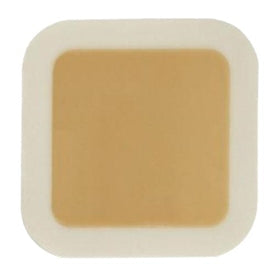
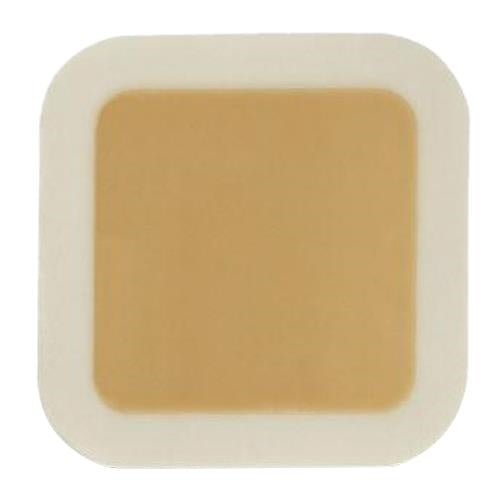
ConvaTec DuoDerm CGF Border Hydrocolloid Dressing — Control Gel Formula, Foam Border
/


ConvaTec DuoDerm CGF Border Hydrocolloid Dressing — Control Gel Formula, Foam Border, 5 Sizes Including Triangle
Proprietary Control Gel Formula. Wide foam border — no tape needed. Two triangle shapes for hard-to-dress anatomy. ConvaTec DuoDerm CGF Border is a sterile, self-adhesive hydrocolloid wound dressing built on ConvaTec's proprietary Control Gel Formula (CGF) — a unique hydrocolloid composition of pectins, gelatins, sodium carboxymethylcellulose, and elastomers that is clinically distinct from standard hydrocolloid dressings. When in contact with wound exudate, the CGF matrix converts to a soft, cohesive gel mass that creates and maintains an optimal moist healing environment, supports autolytic debridement, and allows for low-trauma dressing removal with minimal disruption to healing tissue. The outer polyurethane foam border provides a wide adhesive perimeter that secures the dressing in place without any supplemental tape — even in difficult anatomical locations. Available in five sizes including two anatomically shaped triangle dressings designed specifically for hard-to-dress body contours.
✔ Proprietary CGF Formula — Pectins, Gelatins, CMC & Elastomers ✔ Wide Foam Border — Tape-Free Secure Fixation ✔ Bacterial & Viral Barrier (HBV & HIV) ✔ Hard-to-Dress Area Capability ✔ Triangle Shapes for Contoured Anatomy ✔ Latex-Free
Product Details & Available Sizes
| Manufacturer | ConvaTec |
|---|---|
| Dressing Type | Hydrocolloid — CGF (Control Gel Formula) |
| CGF Formula Composition | Pectins, Gelatins, Sodium Carboxymethylcellulose (CMC), Elastomers — unique ConvaTec proprietary formulation |
| Border Construction | Wide polyurethane foam outer border with adhesive skin contact layer — no supplemental tape required |
| Exudate Level | Light to moderate exudate — not for heavily draining wounds |
| Bacterial/Viral Barrier | Protects against harmful bacteria; proven barrier against HBV and HIV |
| Wear Time | Up to 7 days — change when dressing is saturated or clinical condition warrants |
| Sterility | Sterile |
| Latex | Not made with natural rubber latex |
| HCPCS Codes | A6237, A6238 |
| 187970 | 2½" x 2½" Square — Box of 5 |
| 187971 | 4" x 4" Square — Box of 5 |
| 187972 | 6" x 6" Square — Box of 5 |
| 187973 | 4" x 5" Triangle — Box of 5 |
| 187974 | 6" x 7" Triangle — Box of 5 |
Indicated For — Wound Types
- Pressure ulcers / pressure injuries — Stage II, III, and IV
- Dermal ulcers — venous leg ulcers, arterial ulcers, diabetic foot ulcers
- Full-thickness wounds
- Superficial wounds
- Partial thickness (second-degree) burns
- Donor sites
- Hard-to-dress anatomical locations — contoured body surfaces where square dressings lift or fail to conform
Contraindications: Not indicated for heavily exudating wounds — for high-drainage wounds a foam or alginate primary dressing is more appropriate. Not for use on infected wounds without concurrent clinical management. Not for third-degree burns or surgical implantation.
The CGF Formula — What Makes DuoDerm Different from Standard Hydrocolloid
Standard hydrocolloid dressings are built primarily on a carboxymethylcellulose (CMC) base — a single hydrogel-forming polymer that absorbs exudate and swells into a gel at the wound surface. DuoDerm CGF uses a more complex, proprietary formula that combines four distinct components: pectins, gelatins, CMC, and elastomers. Each component contributes a different mechanical and functional property to the finished dressing.
- Pectins — plant-derived polysaccharides that provide initial gel-forming capacity and contribute to the dressing's ability to absorb a broad spectrum of wound exudate components, including proteins and inflammatory mediators
- Gelatins — protein-based polymer that adds structural body to the gel mass as it forms, helping the dressing maintain a consistent, cohesive gel that doesn't thin out or fragment during the wear period
- Sodium Carboxymethylcellulose (CMC) — the primary hydrophilic absorbent polymer, responsible for moisture uptake and the conversion of the hydrocolloid matrix from solid to gel state on contact with wound exudate
- Elastomers — rubber-like polymers that provide the dressing matrix with flexibility and conformability, allowing the dressing to move with the body and maintain contact with wound surfaces that change shape during activity
The result of this four-component formula is a gel mass that forms more completely, holds together more cohesively, and releases from the wound surface more cleanly than single-polymer hydrocolloids. The gel forms a soft, moist interface between the wound surface and the dressing that supports autolytic debridement — the body's own enzyme-driven process of breaking down necrotic and sloughy wound tissue — while protecting granulation tissue from trauma at dressing change. The dressing also provides a continuous bacterial and viral barrier, with documented effectiveness against HBV and HIV.
- Multi-component CGF formula — more complete gel formation than single-polymer hydrocolloids
- Cohesive gel mass — holds together cleanly, minimal residue in wound bed at dressing change
- Creates and maintains optimal moist wound healing environment throughout wear period
- Supports autolytic debridement — gel environment activates the body's own debridement enzymes
- Bacterial and viral barrier — documented protection against HBV and HIV throughout wear
- Occlusive construction — isolates wound from external contamination and environmental bacteria
- Low-trauma removal — cohesive gel lifts away without disrupting healing tissue or granulation bed
The Foam Border — Why It Matters for Hard-to-Dress Areas
DuoDerm CGF Border's outer polyurethane foam border is not simply a convenience feature — it is the structural reason this dressing is specifically appropriate for hard-to-dress anatomical locations. Standard hydrocolloid dressings rely on the adhesive underside of the hydrocolloid pad itself to maintain wound contact. On flat, stable wound sites this works well, but on curved or mobile surfaces — the heel, elbow, shoulder, sacrococcygeal area, between the toes, or any joint — the pad edge experiences repeated mechanical stress from movement and contour changes that causes progressive edge lift and dressing loss.
The wide foam border extends beyond the hydrocolloid pad on all sides, distributing the adhesive contact area across a much larger perimeter of healthy periwound skin. The foam material is flexible and compressible — it conforms to body contours that would cause a rigid border to peel — and its adhesive properties remain stable across the range of motion experienced at joint and contoured wound sites. This allows DuoDerm CGF Border to maintain secure, tape-free fixation in locations where standard bordered or non-bordered hydrocolloids routinely fail prematurely.
- Wide foam border — distributes adhesive hold across a larger perimeter than hydrocolloid-only dressings
- Flexible, compressible foam — conforms to curved and mobile anatomical surfaces without peeling
- No supplemental tape required — the border is the fixation system
- Designed for hard-to-dress areas — heels, elbows, sacrum, joints, and contoured body surfaces
- Extended wear time — secure border prevents the premature edge lift that cuts short standard hydrocolloid wear
Square vs. Triangle Sizes — Which Shape Is Right?
The three square sizes (187970, 187971, 187972) are the standard choice for most flat, accessible wound surfaces — pressure injuries over flat bony prominences, diabetic foot ulcers on a flat plantar surface, surgical wounds, and venous ulcers on a flat medial leg surface. Square dressings provide the most efficient coverage area per dressing and are the most common configuration for general wound management.
The two triangle sizes (187973, 187974) exist specifically for wound locations where square geometry fails to conform — most notably the sacral/coccygeal area and the heel. These are the two most common high-risk pressure injury sites in clinical practice, and they are also the sites where standard square dressings most often fail early due to the curved, multi-plane anatomy and the mechanical stress generated by positioning changes in bed-bound patients. The triangle shape follows the natural contour of the sacrum and the posterior heel, placing the adhesive foam border along anatomical lines rather than across them, which dramatically improves dressing conformity, edge seal, and overall wear time at these critical sites.
- 187970 — 2½" x 2½" Square: Small wounds, early-stage pressure injuries, superficial wounds on flat compact surfaces
- 187971 — 4" x 4" Square: Standard size — the most commonly used; typical pressure ulcers, diabetic foot ulcers, venous leg ulcers, donor sites, and burns of average dimension
- 187972 — 6" x 6" Square: Larger wounds requiring broader coverage — extensive pressure injuries, large donor sites, wider venous ulcers, or any wound where a 4x4 would not provide adequate margin coverage
- 187973 — 4" x 5" Triangle: Smaller sacral and heel wounds — Stage II–III sacral pressure injuries of moderate size and posterior heel ulcers where the triangular shape provides superior anatomical conformity
- 187974 — 6" x 7" Triangle: Larger sacral and heel wounds — Stage III–IV sacral pressure injuries and larger heel ulcers requiring maximum triangle coverage; also appropriate for any contoured wound site where the larger triangle footprint provides better coverage than the 4x5
Not sure which size or shape fits your wound? Call 1-866-218-0902 — Mon–Fri, 9am–5pm EST
DuoDerm CGF Border vs. DuoDerm CGF Sterile (Non-Bordered)
DuoDerm CGF is available in two configurations — the Border version (this product) and the non-bordered Sterile Dressing version. Both share the identical CGF hydrocolloid formula and provide the same wound healing environment. The distinction is entirely in fixation:
- CGF Border (this product): Self-contained — the foam border is the fixation system. No tape, no secondary dressing needed for most wounds. Best for hard-to-dress areas, home care patients, and any setting where simplicity and one-step application are priorities.
- CGF Sterile (non-bordered): Requires tape or a secondary dressing for fixation. Better for patients with adhesive sensitivity across a large periwound area, wounds where the clinician needs custom fixation, or wounds being used under compression bandaging where an outer border would interfere with wrap application.
Why Buy From Medical Department Store?
- 30+ years serving home medical and wound care customers — A+ BBB Rated
- 110% Low Price Guarantee — we beat any competitor
- Medical supply specialists on the phone, not a call center
- Ships to all 50 states — 5 Southwest Florida locations for local pickup
Questions about DuoDerm CGF Border or any of our hydrocolloid wound dressings? Call 1-866-218-0902 — our team is ready to help.