Kendall Ultec Pro Alginate Hydrocolloid Dressing — 30% Alginate, Thin Profile
/


Kendall Ultec Pro Alginate Hydrocolloid Dressing — 30% Alginate, Thin Profile, 7 Sizes Including Sacral
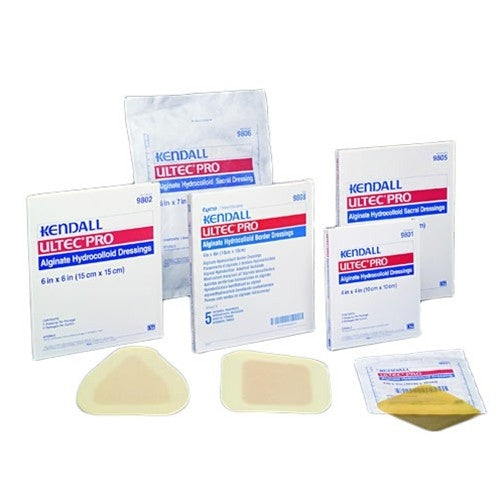
Two dressing technologies. One thin, conformable, occlusive dressing. Kendall Ultec Pro Alginate Hydrocolloid Dressings combine the moist wound healing and bacterial barrier properties of hydrocolloid with the enhanced absorbency of a 30% alginate formulation — producing a dressing that handles more exudate than standard hydrocolloid alone while maintaining the occlusive seal and extended wear characteristics hydrocolloid is known for. The thin, highly flexible profile reduces the two most common failure points of traditional hydrocolloid dressings: edge roll-up from mechanical friction and melt-down of dressing material into the wound site. The result is a dressing that stays in place longer, changes less frequently, conforms better to irregular surfaces and anatomy, and provides an effective barrier against bacteria and external fluids throughout the wear period. Available in seven configurations — non-adhesive pads, adhesive bordered pads, and two dedicated sacral shapes — to match wound location and fixation need.
✔ 30% Alginate Formula — Greater Absorbency Than Standard Hydrocolloid ✔ Thin Profile — Reduced Roll-Up & Melt-Down Risk ✔ Occlusive — Optimal Moist Environment & Bacterial Barrier ✔ Bordered Edge — Easy One-Handed Application ✔ Sacral Shapes Available — Designed for Sacral Wound Anatomy
Product Details & Available Sizes
| Manufacturer | Kendall / Covidien / Medtronic |
|---|---|
| Dressing Type | Alginate hydrocolloid — hybrid construction combining hydrocolloid matrix with 30% alginate content |
| Alginate Content | 30% — provides greater absorbency and reinforced dressing integrity vs. standard hydrocolloid |
| Profile | Thin, highly flexible — reduces roll-up and melt-down risk; improves conformability |
| Moisture Environment | Occlusive — maintains optimal moist wound healing environment throughout wear period |
| Bacterial Barrier | Occlusive construction provides effective barrier against bacteria and external fluids |
| Exudate Level | Light to moderate — not for heavily exudating wounds |
| Sterility | Sterile |
| Packaging | Water-resistant, tamper-evident packaging opens easily for sterile presentation |
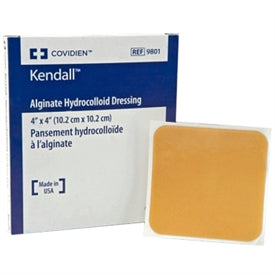
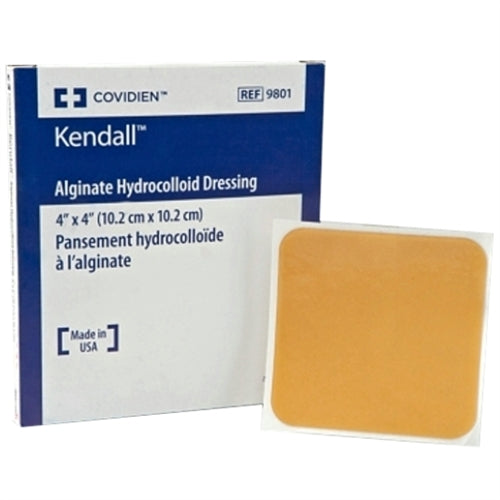
| 9801 | Non-Adhesive — 4" x 4" — Box of 5 |
| 9802 | Non-Adhesive — 6" x 6" — Box of 5 |
| 9807 | Adhesive Bordered — 2½" x 2½" — Box of 5 |
| 9808 | Adhesive Bordered — 4" x 4" — Box of 5 |
| 9809 | Adhesive Bordered — 6" x 6" — Box of 5 |
| 9805 | Adhesive Bordered Sacral — 4" x 5" — Box of 5 |
| 9806 | Adhesive Bordered Sacral — 6" x 7" — Box of 5 |
Indicated For — Wound Types
- Stage I through Stage IV pressure ulcers
- Dermal ulcers — venous, arterial, diabetic
- Donor sites
- Second degree (partial thickness) burns
- Superficial wounds
- Light to moderately exudating partial and full thickness wounds
Not indicated for: Heavily exudating wounds — for moderate-to-heavy drainage, a dedicated alginate or foam dressing is more appropriate. Not for infected wounds without concurrent clinical management.
How Ultec Pro Works — The Alginate Hydrocolloid Hybrid
Standard hydrocolloid dressings are built on a gel-forming colloid matrix — typically carboxymethylcellulose (CMC) — that absorbs exudate and swells into a gel mass that creates and maintains a moist wound healing environment under the occlusive film backing. This mechanism works well for light drainage wounds but has two well-documented limitations: absorption capacity is constrained by the hydrocolloid matrix alone, and as the dressing absorbs and swells at the edges, edge lift and roll-up under friction are common failure points. The thick profile of many traditional hydrocolloids also increases the risk that the softened dressing center can be pressed into the wound bed — "melt-down" — particularly under compression or in high-movement locations.
Ultec Pro addresses both issues through its 30% alginate formulation integrated into the hydrocolloid matrix. The alginate component adds a second absorbent mechanism — calcium alginate fiber absorption and gel formation — that works alongside the hydrocolloid to process exudate more efficiently. The combined matrix absorbs more fluid than hydrocolloid alone before reaching saturation, which extends wear time, reduces change frequency, and better prevents the lateral exudate spread that causes periwound maceration. The higher alginate content also reinforces the structural integrity of the dressing as it gels — the dressing holds its form more consistently across the wear period, reducing the gel fragmentation and melt-down tendency of lower-integrity hydrocolloids. The thinner overall profile keeps the dressing flexible and low-profile against the wound surface, reducing mechanical edge stress and the roll-up that leads to premature dressing failure.
- 30% alginate content — boosts absorption and integrity beyond standard hydrocolloid capacity
- Dual-mechanism absorption — hydrocolloid CMC gel and alginate fiber gel work together to process exudate
- Reinforced integrity — dressing holds form as it absorbs, resists melt-down into wound site
- Thin profile — better conformability to wound contours, reduced edge roll-up under friction and movement
- Occlusive construction — maintains optimal moist healing environment; effective barrier to bacteria and external fluids throughout wear period
- Unique formulation absorbs exudate while helping prevent that exudate from spreading to and macerating periwound skin
- Extended wear time — greater absorbency means fewer dressing changes, reducing cost and patient disruption
Non-Adhesive vs. Adhesive Bordered — Which Variant Is Right?
- Non-Adhesive (9801, 9802): The dressing pad without an adhesive border — requires a separate secondary dressing or tape to secure in place. Preferred when the periwound skin is fragile, sensitized, or already irritated by adhesives; when the clinician needs custom fixation; or when the dressing will be used under a compression system that provides its own hold. Better choice for patients with a history of adhesive sensitivity or skin stripping on dressing removal.
- Adhesive Bordered (9807, 9808, 9809): The dressing pad is surrounded by a self-adhesive hydrocolloid border that secures the dressing in one step without tape or secondary fixation. The bordered edge allows easy one-handed application — peel, center over wound, smooth border down. Ideal for home care users, patients managing their own dressings, and clinical settings where application speed and simplicity matter. The adhesive border also provides an additional seal against bacterial entry at the dressing perimeter.
- Sacral Bordered (9805, 9806): Same adhesive bordered construction as the standard bordered variants, but shaped to conform to sacral anatomy. The contoured shape addresses the challenge that square or rectangular dressings face over the sacrum — corners and straight edges don't conform well to the curved, high-motion surface of the sacrococcygeal area, leading to early edge lift and dressing loss. The sacral shape is designed to follow the natural contours of the sacrum, improving adhesion and wear time in one of the most challenging pressure injury locations in wound care.
Choosing the Right Size
- 9807 / 2½" x 2½" Bordered: Smallest bordered size — for small wounds, early-stage pressure injuries on bony prominences, superficial dermal wounds, and sites where a compact dressing footprint is needed
- 9801 / 9808 — 4" x 4" Non-Adhesive & Bordered: Standard size for typical pressure ulcers, dermal ulcers, surgical wounds, and donor sites of average dimensions — the most commonly used size in this line
- 9802 / 9809 — 6" x 6" Non-Adhesive & Bordered: For larger wounds requiring broader coverage — wide pressure injuries, extensive burns, larger venous ulcers, and wounds where the 4x4 would not provide adequate wound-plus-perimeter coverage
- 9805 — 4" x 5" Sacral Bordered: Smaller sacral shape for moderate-size sacral wounds — provides anatomically appropriate coverage for Stage I–II sacral pressure injuries and early-stage sacral ulcers
- 9806 — 6" x 7" Sacral Bordered: Larger sacral shape for more extensive sacral wounds — Stage III–IV pressure injuries, deeper sacral ulcers, or larger sacral surface areas requiring full coverage
Not sure which size or variant is right for your wound? Call 1-866-218-0902 — Mon–Fri, 9am–5pm EST
Why Buy From Medical Department Store?
- 30+ years serving home medical and wound care customers — A+ BBB Rated
- 110% Low Price Guarantee — we beat any competitor
- Medical supply specialists on the phone, not a call center
- Ships to all 50 states — 5 Southwest Florida locations for local pickup
Questions about Ultec Pro or any of our hydrocolloid wound dressings? Call 1-866-218-0902 — our team is ready to help.