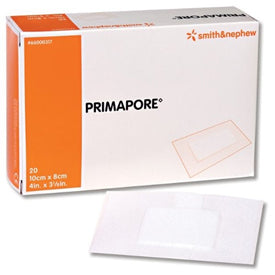
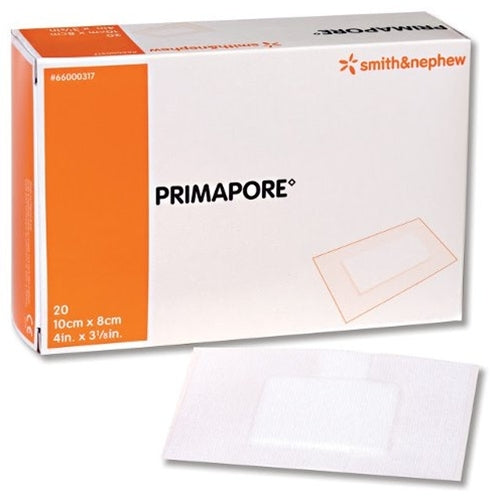
Smith & Nephew Primapore Adhesive Non-Woven Wound Dressing — Polyester Contact Layer
/


Smith & Nephew Primapore Adhesive Non-Woven Wound Dressing — Polyester Contact Layer, Low-Allergy Adhesive, 6 Sizes
Three-layer island dressing. Polyester contact layer. Low-allergy acrylic adhesive. Slit protector paper for aseptic application. Smith & Nephew Primapore is a sterile, self-contained adhesive island dressing built for post-operative wounds, sutured wounds, and any site requiring a water-resistant, conformable, protective cover. The three-layer construction places a low-adherent polyester wound contact layer directly against the wound surface — allowing blood and exudate to pass through into the thick absorbent pad above while maintaining the wound environment and minimizing pain and tissue disruption on removal. A soft, breathable non-woven backing bonded with a low-allergy acrylic adhesive holds the dressing in place without restricting movement or causing adhesive trauma to the surrounding skin. The slit protector paper system allows quick, aseptic one-step application without fingers or forceps touching the pad or adhesive surface. Available in six sizes — including a dedicated 2" x 3" IV/peripheral line size and sizes scaled to central line management — to cover post-operative wounds from small incisions to large surgical sites.
✔ Polyester Wound Contact Layer — Low Adherent, Minimal Pain on Removal ✔ Thick Absorbent Pad — Minimizes Fluid Strike-Through ✔ Low-Allergy Acrylic Adhesive — Evenly Spread, Secure Hold ✔ Water-Resistant Backing — Repels Water and External Contaminants ✔ Slit Protector Paper — Aseptic One-Step Application ✔ 6 Sizes Including Dedicated IV Dressing
Product Details & Available Sizes
| Manufacturer | Smith & Nephew |
|---|---|
| Construction | Three layers: water-resistant non-woven backing / thick absorbent pad / low-adherent polyester wound contact layer |
| Wound Contact Layer | Polyester — low adherent, allows passage of blood and exudate into pad, minimal pain and tissue disruption on removal |
| Absorbent Pad | Thick, highly absorbent — minimizes fluid strike-through, protects wound from trauma |
| Backing | Soft, breathable, water-resistant non-woven — repels water and external contaminants |
| Adhesive | Low-allergy acrylic — evenly spread across the non-woven surface for consistent, secure fixation |
| Application System | Slit protector paper — paper is slit across the width of the dressing, enabling application without fingers or forceps touching the pad or adhesive area |
| Sterility | Sterile |
| Latex | Latex-free |
| 7133 | 2" x 3" — IV/Peripheral Line Size — Box of 100 |
| 66000317 | 4" x 3⅛" — Box of 20 |
| 66000318 | 6" x 3⅛" — Box of 20 |
| 66000319 | 8" x 4" — Box of 20 |
| 66000321 | 11¾" x 4" — Box of 20 |
| 7139 | 13¾" x 4" — Box of 20 |
Indicated For — Wound Types & Sites
- Post-operative wounds — primary use case for all sizes above 4"
- Sutured wounds — polyester contact layer minimizes disturbance to suture lines on dressing removal
- Minor cuts, abrasions, lacerations, and puncture sites requiring a water-resistant cover
- IV sites — peripheral IV lines (2" x 3" size, #7133); central lines (4" x 3⅛" and 6" x 3⅛" sizes)
- Sites requiring bacterial contamination prevention with water-resistant protection
- Secondary dressing over gels, ointments, pastes, and primary wound dressings
- Difficult anatomical locations requiring a conformable, flexible dressing — shoulders, axillae, elbows, and high-motion joints
How Primapore Is Built — Layer by Layer
Primapore's performance comes from the relationship between its three layers, each engineered to solve a specific failure point in standard adhesive island dressings.
Layer 1 — Polyester Wound Contact Layer: This is the layer that sits directly on the wound surface. It is not gauze, not foam, and not CMC — it is a low-adherent polyester mesh that functions as a one-way filter. Blood and exudate pass up through the polyester weave into the absorbent pad above, but the polyester does not bond to the wound bed as it gels or dries. The result is a wound contact surface that maintains a good healing environment, protects granulation tissue, and lifts away at dressing change with minimal pain and minimal disruption to the wound surface — significantly reducing the tissue trauma that occurs when standard gauze pads adhere to drying wound exudate.
Layer 2 — Thick Absorbent Pad: The central pad is engineered to be thick enough to absorb and retain wound exudate without fluid strike-through reaching the outer surface of the dressing. Strike-through — the visible saturation of the outer dressing backing — is both an infection risk (creating a pathway for external bacteria to reach the wound) and a comfort issue for patients. The thick pad design maximizes the distance and absorbent capacity between the wound surface and the dressing exterior, reducing both risks and protecting the wound from incidental trauma and external pressure.
Layer 3 — Water-Resistant Non-Woven Backing with Low-Allergy Acrylic Adhesive: The outer backing is a soft, breathable non-woven material that repels water and external contaminants — allowing the patient to shower and perform normal daily activities without dressing compromise. The adhesive is a low-allergy acrylic formula, evenly applied across the full backing surface rather than in a perimeter border only, providing consistent fixation across the wound site. The even adhesive distribution reduces edge lift and dressing shift during movement, and the low-allergy formulation minimizes the skin sensitization and contact dermatitis risk that standard rubber-based adhesives carry for repeated-use patients.
- Polyester wound contact layer — low adherent, one-way fluid passage, minimal pain on removal
- Thick absorbent pad — prevents strike-through, protects wound from trauma and external pressure
- Water-resistant non-woven backing — repels water and bacteria, allows daily activity
- Low-allergy acrylic adhesive — evenly spread, consistent fixation, reduced sensitization risk
- Soft and highly conformable — maintains full range of motion at joints and difficult anatomical locations
- Slit protector paper — aseptic application without touching pad or adhesive, reducing contamination risk
- Latex-free — safe for patients with latex sensitivity
Primapore as an IV Site Dressing
The 2" x 3" size (#7133) is specifically designed and sized for peripheral IV line management. The compact footprint fits the catheter hub and insertion site cleanly, the water-resistant backing protects the site from shower and hand-washing contamination, and the one-step island construction combines the catheter securement function of tape with the site protection function of a gauze pad in a single sterile unit. The 4" x 3⅛" (#66000317) and 6" x 3⅛" (#66000318) sizes scale up appropriately for central venous catheter dressings where a larger sterile coverage area around the insertion site is required per protocol.
Primapore as a Secondary Dressing
Primapore is widely used as a secondary cover dressing over primary wound fillers, gels, ointments, and pastes. When a primary dressing such as an alginate, hydrogel, collagen, or enzymatic debriding agent is placed in the wound bed, it typically requires a secondary dressing to hold it in place, provide an outer barrier, and add absorbency for exudate that passes through the primary layer. Primapore's low-adherent polyester contact layer means it will not adhere to the underlying primary dressing, making secondary dressing changes clean and non-disruptive to the primary layer. The water-resistant backing adds bacterial protection across the full dressing area, and the conformable non-woven construction holds the primary dressing securely in place without the need for tape.
Choosing the Right Size
- 7133 — 2" x 3": Dedicated peripheral IV and small puncture site dressing — the smallest size, engineered for catheter site management and small puncture wounds