Pulse Dose Portable Oxygen Concentrators — Southwest Florida & Nationwide
Pulse dose portable oxygen concentrators detect the moment you begin to inhale and deliver a precise burst of oxygen timed to your breath. Between breaths, they deliver nothing — which is why pulse dose units are lighter, run longer on battery, and travel farther than any continuous flow device. The lightest unit we carry weighs 2.8 lbs and fits in a fanny pack. The most capable delivers seven pulse settings in under 4.4 lbs.
For patients with COPD, pulmonary fibrosis, or other respiratory conditions prescribed supplemental oxygen during waking hours, a well-matched pulse dose concentrator is what makes a full day away from home possible again — the Publix trip, the grandchild's school event, the flight to see family, the morning walk on the beach — without planning around a tank or a charging stop.
Medical Department Store carries the full pulse dose lineup, available for hands-on demonstration at our five Southwest Florida showrooms, with a 10-Day No-Risk Trial and licensed Respiratory Therapists on staff. Not in Southwest Florida? We ship to all 50 states.
📞 866-218-0902 | ✉ support@medicaldepartmentstore.com
Is Pulse Dose Right for You — or Do You Need Continuous Flow?
Your prescription determines the answer — and getting this wrong is the most common and most costly mistake we see in portable oxygen buying.
Pulse dose is appropriate when your prescription specifies a pulse dose setting (1 through 6 or higher), your physician has not indicated a need for nighttime oxygen delivery, and you do not use a CPAP or BiPAP machine that requires a pressurized oxygen source. Pulse dose units are the right choice for the majority of active patients who need supplemental oxygen during daytime hours and travel.
Continuous flow is required when your prescription specifies a liters-per-minute rate, when you need oxygen during sleep, or when your breathing pattern or condition requires uninterrupted delivery that pulse dose cannot reliably provide. If any of these apply, pulse dose is not a substitute — regardless of how much lighter the unit is.
One important detail most buyers miss: pulse dose "setting 2" is not a standardized measurement. Different manufacturers calibrate differently — the bolus volume, delivery timing, and breath detection sensitivity all vary between brands. A Respiratory Therapist can verify that the specific unit you are considering actually delivers what your physician intended at your setting. That is a five-minute conversation that can save weeks of diminished quality of life. 📞 866-218-0902
What to Know Before Choosing a Pulse Dose Concentrator
Your pulse setting determines your options. Units in our lineup range from settings 1–3 (Inogen G4, the lightest available) to settings 1–7 (Rhythm P2-E7, the highest pulse range per pound of any unit we carry). If your prescription may advance, buying headroom now — a unit with higher maximum settings than you currently need — may be the more economical long-term decision.
Weight you carry repeatedly matters more than weight on a spec sheet. The difference between a 2.8-lb unit and a 4.7-lb unit is real at 4 PM on a difficult day. The number that matters is not what you can carry once at your best — it is what you can carry a dozen times on a day when you are not feeling your strongest.
Battery life in Southwest Florida heat runs 70–75% of published specs. A unit rated for 13 hours at setting 2 in a controlled lab will likely deliver 9–10 hours on a hot August day in Florida. Plan your longest outing around the real-world number, not the box number.
Flying with a pulse dose concentrator is more straightforward than most people expect — but preparation matters. Every pulse dose unit we carry is FAA-approved for domestic commercial flights. Bring enough battery for 150% of total travel time including boarding, connection, and potential delays. Call us before your first flight with a new unit. 866-218-0902
Hurricane preparedness is not optional in Southwest Florida. Know your battery hours, your DC car power options, and your generator compatibility before a storm is named. Come in in April or May — we will build an actual plan for your specific equipment and situation, not hand you a generic checklist.
For the complete buying guide written by our Respiratory Therapist team: 12 Questions to Answer Before You Buy a Portable Travel Oxygen Concentrator →
Why Buy from Medical Department Store?
Respiratory Therapists on staff. Licensed clinical professionals who verify that the unit you are considering actually delivers your prescribed setting — not just a unit that covers your setting range on the spec sheet. Pulse dose calibration varies significantly between manufacturers. We check this before you leave the store.
10-Day No-Risk Trial. Take any concentrator home. Use it for 10 days on your actual schedule. If it is not right — too heavy by mid-afternoon, too loud at a restaurant, battery timing that does not match your day — bring it back and we exchange it. No restocking fee. No fine print. No other retailer can offer you this.
Medicare billing handled directly. We verify your coverage before you make any decisions. Bring your Medicare card and prescription when you visit — or call ahead and we will check before you come in.
Service for every brand, every model. We repair and service all pulse dose concentrators regardless of where you bought them — at all five Southwest Florida locations, with home service calls available. Read our portable oxygen concentrator maintenance guide to keep your unit performing at prescription spec between visits.
Nationwide shipping. Not in Southwest Florida? We ship to all 50 states with expert pre- and post-purchase support by phone and email.
Pulse Dose Portable Oxygen Concentrator — Frequently Asked Questions
What exactly is a pulse dose portable oxygen concentrator?
A pulse dose concentrator — also called demand flow — listens for the moment you begin to inhale and delivers a precise bolus of oxygen timed to arrive at your airway just as your lungs are opening. Between breaths it delivers nothing, which is why these units can carry smaller batteries, run far longer, and weigh significantly less than continuous flow devices. The tradeoff: they require an active breath to trigger delivery, which is why physician guidance is needed before using pulse dose during sleep.
Can I use a pulse dose concentrator while I sleep?
This depends on your prescription and breathing pattern — and it is a question your physician needs to answer specifically for you, not a general yes or no. During sleep, breathing becomes shallower and slower. Many pulse dose concentrators are calibrated to detect the breath rate of an awake, active person and may miss the quieter breathing of sleep. If your prescription includes nighttime oxygen, tell us before we recommend anything. It will likely point us toward a continuous flow or dual-mode unit instead.
Are pulse dose concentrators approved for air travel?
Every pulse dose unit we carry is FAA-approved for domestic commercial flights. For international travel, voltage requirements and airline documentation rules vary by carrier and route. Our rule: bring enough battery for 150% of your total travel time — boarding, flight, connection, and potential delays. Call us before you book your first flight with a new unit and we will walk you through exactly what your airline will need. 866-218-0902
What is the lightest pulse dose concentrator available?
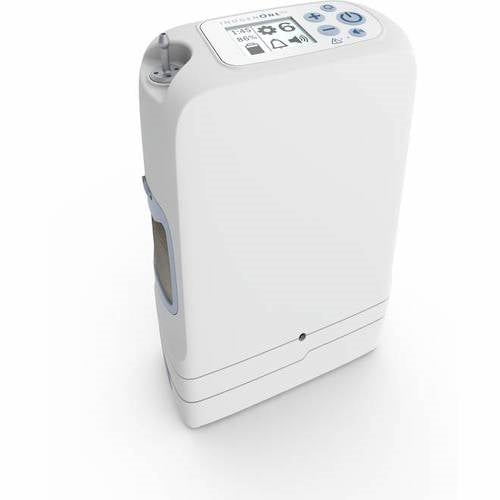
The Inogen One G4 at 2.8 lbs with a single battery — the lightest portable oxygen concentrator on the market. It covers pulse dose settings 1–3 and fits in a hip bag or tote. The tradeoff is battery life: up to 2.6 hours on the single battery, up to 5 hours on the double. For patients on settings 1–3 who are always within reach of AC power, it is in a category by itself. For longer outings, the Inogen G5, Rove 6, or OxyGo NEXT offer extended battery life at slightly more weight.
What is the difference between pulse dose settings — does setting 2 mean the same thing on every unit?
No — and this is one of the most important things to understand before buying. Pulse dose settings are not standardized across manufacturers. The bolus volume, delivery timing, and breath detection sensitivity all vary between brands. Setting 2 on one unit may deliver meaningfully more or less oxygen than setting 2 on another. A Respiratory Therapist can verify that the unit you are considering actually delivers what your physician intended at your specific setting. This is a conversation we have with every patient before we make a recommendation. 866-218-0902
Does Medicare cover a pulse dose portable oxygen concentrator?
Medicare Part B may cover portable oxygen equipment with a qualifying diagnosis and physician documentation. We handle Medicare billing directly — call us before your visit with your Medicare card and prescription and we will verify your coverage first. 866-218-0902 | support@medicaldepartmentstore.com
Do you service pulse dose concentrators you did not sell?
Yes — every brand, every model, regardless of where it was purchased, at all five Southwest Florida locations. Home service calls available for patients who cannot come in. 866-218-0902
Can I try a pulse dose unit at home before committing to buy it?
Yes. Our 10-Day No-Risk Trial is exactly what it says. Take any concentrator home, use it for 10 days on your actual schedule, and exchange it if it is not the right fit — no restocking fee, no fine print. Walk-ins welcome at all five Southwest Florida locations, or call ahead for home delivery.
Related Resources
Five Southwest Florida Locations — Walk In Anytime
Respiratory Therapists on staff · Hands-on demonstrations · 10-Day No-Risk Trial · Medicare billing · Repairs for all brands and models
📞 866-218-0902 | ✉ support@medicaldepartmentstore.com
Monday–Friday 9AM–5PM | Saturday 9AM–3PM | Nationwide shipping available