

3M Steri-Strip Reinforced Adhesive Skin Closures
/


3M Steri-Strip Reinforced Adhesive Skin Closures
SKUs: R1540 | R1541 | R1542 | R1546 | R1547 | R1548 | R1549
Reinforced Non-Woven Adhesive Strips | Polyester Filament Strength | Microporous Breathable Backing | Hypoallergenic | Up to 14-Day Wear | Permits Early Suture Removal | FSA Eligible | Latex Free | By Solventum (Formerly 3M)
Medical-grade adhesive skin closure strips for approximating and supporting wound edges on small lacerations and incisions — without sutures or staples. A low-profile strip of polyester filaments embedded in the backing gives each strip reinforced tensile strength that standard non-woven strips cannot match. The microporous non-woven backing breathes, reducing moisture accumulation under the strip. Hypoallergenic adhesive minimizes skin reaction risk. Applied correctly, Steri-Strips support wound edges long enough to permit early removal of sutures or staples, reducing scarring risk. Up to 14-day wear. Used in emergency departments, operating rooms, clinics, and physician's offices. FSA eligible. Latex free. By Solventum (formerly 3M Health Care).
Order by Part Number
| SKU | Width × Length | Strips per Envelope | Best For | Quantity Options |
|---|---|---|---|---|
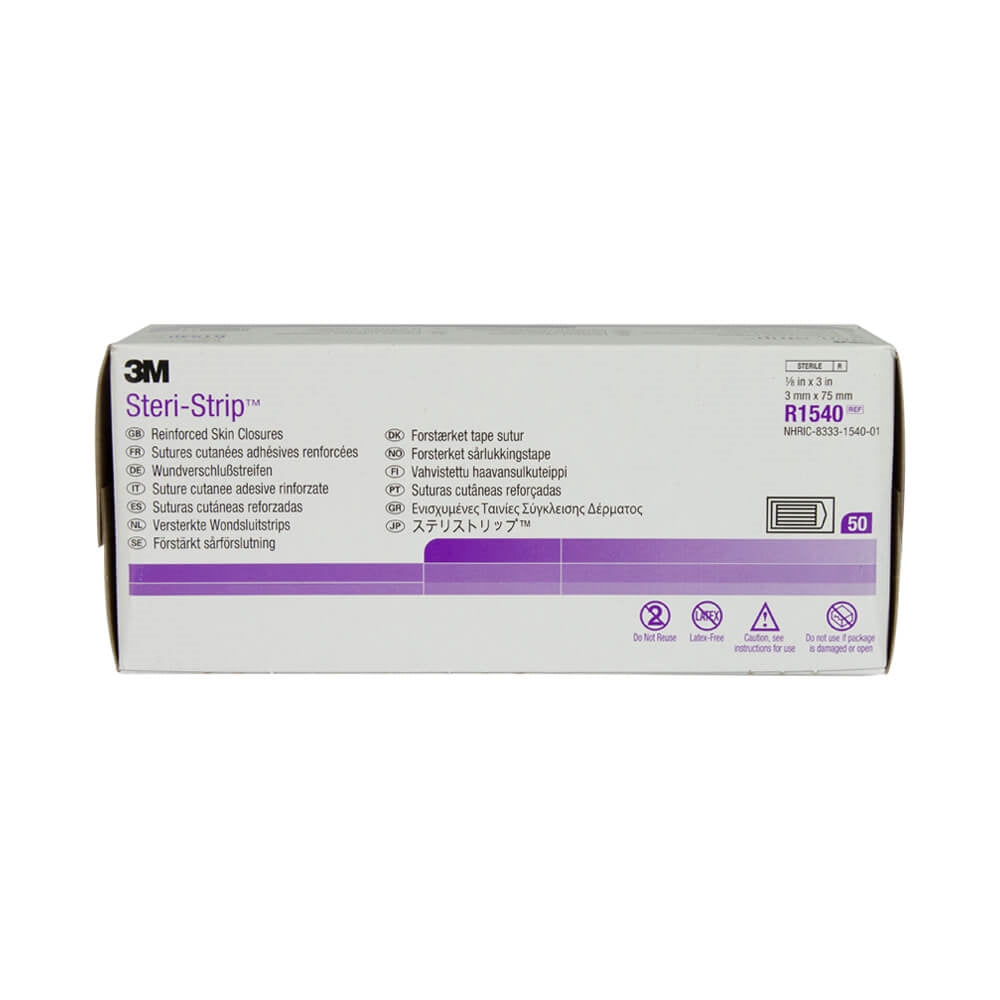
| R1540 | 1/8" × 3" (3mm × 75mm) | 5 | Narrow lacerations, facial wounds | Each | 5-pk | 50-pk |
| R1541 | 1/4" × 3" (6mm × 75mm) | 3 | Standard short lacerations | Each | 50-pk |
| R1542 | 1/4" × 1-1/2" (6mm × 38mm) | 6 | Short wounds, pediatric use | Each | 50-pk |
| R1546 | 1/4" × 4" (6mm × 100mm) | 10 | Standard lacerations, most common size | Each | 50-pk | 200/Case |
| R1547 | 1/2" × 4" (12mm × 100mm) | 6 | Wider wounds, higher-tension sites | Each | 50-pk | 200/Case |
| R1548 | 1" × 5" (25mm × 125mm) | 4 | Wide wounds, post-surgical incisions | Each | 25-pk |
| R1549 | 1/2" × 2" (12mm × 50mm) | — | Short wider wounds | Each |
Select width based on wound width; select length based on wound length with enough overlap on each side for secure adhesion. Questions? 1-866-218-0902
Key Features
- Polyester filament reinforcement — a low-profile strip of polyester fiber embedded in the backing adds exceptional tensile strength; resists tearing under wound tension better than unreinforced strips
- Microporous non-woven backing — allows moisture vapor transmission and air circulation to the wound surface; reduces risk of maceration under the strip
- Pressure-sensitive hypoallergenic adhesive — strong bond to dry skin without sensitizing the surrounding area
- Permits early suture and staple removal — when Steri-Strips are applied after suture/staple removal, they maintain wound approximation and allow wound edges to fully consolidate before all external support is removed
- Reduces scarring risk — supporting wound edges with adhesive strips reduces the mechanical stress at the wound margins that contributes to widened scars
- Up to 14-day wear — depending on wound location and patient activity level
- Water-resistant — can get wet; prolonged soaking weakens adhesion
- Sterile packaging — each envelope contains sterile strips; appropriate for clinical wound closure
- Used in ED, OR, clinics, physician's offices, same-day surgery centers
- FSA eligible | Latex free | Hypoallergenic
Application Steps
- Clean the wound and dry the surrounding skin thoroughly — strips will not adhere to wet skin. For enhanced adhesion at high-tension or high-moisture sites, apply a thin layer of benzoin tincture to the skin on each side of the wound (not to the wound itself) and allow to become tacky before applying strips.
- Open the sterile envelope and remove the card without contaminating the strips. Bend the card at the perforated end and gently pull back the tab to expose the strips.
- Grasp the end of the strip with forceps or gloved fingers. Lift straight up at a 90° angle — lifting at a lesser angle causes the strip to curl and complicates handling.
- Begin at the center of the wound. Apply one half of the first strip to one side of the wound margin and press firmly. Using fingers or forceps, approximate the skin edges as closely as possible, then press the other half firmly onto the opposite wound margin. Apply without tension — do not stretch or strap the strips.
- Close the remaining wound by sequentially bisecting each remaining open section, or by applying strips approximately 1/8" (3mm) apart, until all edges are approximated.
- Optionally: apply cross stay strips parallel to the wound approximately 1/2" from each end — these "railroad tracks" reduce stress under the tips of the closure strips and lower the risk of skin tension blisters and premature lifting.
Clinical FAQs
What does "reinforced" mean and why does it matter for wound closure strips?
Standard non-woven adhesive skin closure strips rely entirely on the tensile strength of the non-woven backing material. A reinforced strip embeds a low-profile strip of polyester filaments within that backing — polyester fiber has substantially higher tensile strength than the non-woven alone. When a healing wound produces tension at the wound edges (from normal movement, edema, or tissue elasticity), that force is transmitted through the strip. An unreinforced strip may tear or deform under repeated tension over days of wear. The reinforced construction maintains strip integrity through normal activity and daily wound movement over the full wear period. This is why Steri-Strips are specified for clinical wound closure — not just for aesthetic support of already-healed wounds — and why they can support early suture removal when proper approximation has been achieved.
What is the correct technique for approximating wound edges with Steri-Strips?
Wound edge approximation with skin closure strips requires a specific sequence to achieve even, accurate closure. Starting at the midpoint of the wound — rather than one end — ensures that any length mismatch between the two wound edges is distributed symmetrically rather than bunched at one end. After the midpoint strip is placed, each remaining open section is bisected with successive strips: a strip in the center of the left half, then in the center of each resulting quarter, and so on, until edges are fully approximated and strips are approximately 3mm apart. Applying from end to end instead creates cumulative positional errors that leave one end misaligned. Strips must be applied without tension — stretching the strip across the wound creates a bow-stringing effect that elevates the wound edges and increases tension at the margins rather than reducing it.
What are cross stays and when should they be used?
Cross stays — sometimes called railroad tracks — are strips applied parallel to the wound, approximately 1/2" (13mm) from each end of the closure, running perpendicular to the primary closure strips. They are not wound-edge approximation strips; they do not touch the wound. Their purpose is to anchor the ends of the primary closure strips more securely to the surrounding skin, reducing the concentrated peel stress that occurs at each strip's tip as it tries to lift away from the skin. Without cross stays, the primary closure strips are most prone to premature lifting at their ends — particularly in high-movement areas or when the wound is under tension. Adding cross stays distributes that peel stress over a wider area of skin, extending wear time and reducing the risk of tension blisters under the strip tips. Cross stays are especially valuable on wounds near joints or in locations where repeated movement would otherwise cause the strip tips to lift.
How do Steri-Strips support early suture or staple removal?
Wound healing progresses through phases: initial epithelialization at the surface occurs within 5–7 days, but full tensile strength at the dermal layer takes weeks to develop. Sutures and staples are often left in place longer than ideal to maintain approximation during this strength-building period. Steri-Strips allow the clinician to remove sutures or staples earlier — once surface epithelialization is sufficient — while applying strips over the approximated wound to continue supporting the edges as dermal healing consolidates. The strips maintain external apposition without the foreign body response and tissue reaction associated with suture material left in place too long. This approach can reduce cross-hatching scar patterns from suture marks, which form when sutures are left in longer than necessary. The decision to use early removal with strip support is made by the treating clinician based on wound type, location, and patient factors.
Questions about Steri-Strip sizing, wound closure technique, or institutional case pricing? Call our product specialists: 1-866-218-0902