


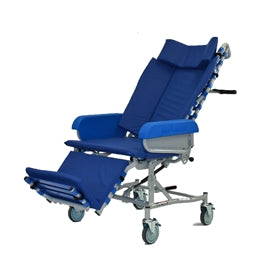

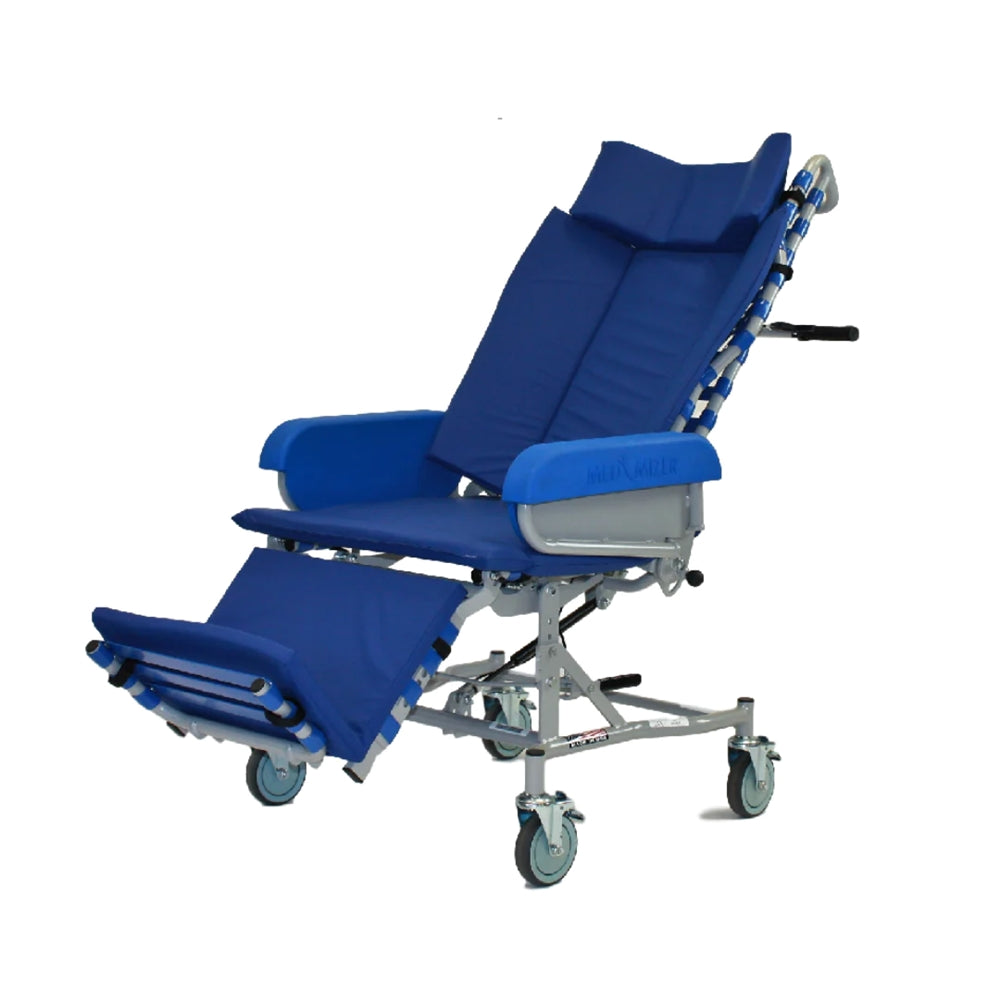


Med-Mizer FlexTilt Tilt-In-Space Chair — Recliner and Tilt



The Med-Mizer FlexTilt is Med-Mizer's first tilt-in-space recliner chair — a clinical positioning chair that provides both independent tilt-in-space (0°–25°) and independent backrest recline (0°–30°) in a manually operated caregiver-pushed chair. Built-in hand controls give the caregiver unlimited positioning without tools. Pressure Relief strapping conforms to the body for clinical pressure management. Dual steering casters reduce caregiver back strain. Three seat widths: 16", 20", and 24". Optional WC19 transport package for vehicle-safe transport. 350 lb capacity. 3-year frame warranty.
Clinical questions — positioning requirements, WC19 transport, or HCPCS documentation? Call 866-218-0902 — Mon–Fri 9AM–5PM · Sat 9AM–3PM
Tilt and Recline — Two Independent Systems
Three Seat Widths — Models & HCPCS
HCPCS: E1161
HCPCS: E1161 / E1039
HCPCS: E1161 / E1039
Key Features
WC19 Transport Package
The WC19 package adds four crash-tested tie-down anchor points and ANSI/RESNA WC19 compliance — required when the user will be transported in a wheelchair-accessible vehicle (WAV) while remaining in the FlexTilt.
Order WC19 if: the chair will be used as a vehicle seat in a WAV, accessible van, or paratransit vehicle. A non-WC19 chair used as a vehicle seat is a safety and liability risk.
Standard FlexTilt (E1161) is correct for: facility-only or home-only use where the chair never serves as a vehicle seat.
No WC19 variant exists for the 16" FT16. Call us if needed: 866-218-0902
Full Specifications
| Manufacturer | Med-Mizer |
|---|---|
| Models | FT16 · FT20 · FT24 · FT20-WC19 · FT24-WC19 |
| HCPCS | E1161 (standard) · E1039 (WC19 transport) |
| Weight Capacity | 350 lbs |
| Product Weight | 85 lbs |
| Degree of Tilt | 0°–25° |
| Degree of Recline | 0°–30° |
| Seat Widths | 16" · 20" · 24" |
| Seat Depth | 16.5"–18" (adjustable — length extender) |
| Seat-to-Floor Height | 19.5"–21.5" |
| Back Height | 32" |
| Frame | Gauge steel 11ga–16ga |
| Casters | 5" dual steering casters |
| Upholstery | Navy padded vinyl |
| Frame Warranty | 3 years — mechanical frame limited |
| Components Warranty | 1 year limited |
Optional Accessories
- WC19 Transport Package — vehicle tie-down (FT20-WC19 / FT24-WC19)
- Foot Bucket — enclosed footrest for positioning and protection
- Lap Belts — positioning and safety belts
- Trays — activity and meal trays
- IV/O2 Holder — for patients on supplemental IV or oxygen
- Stabilizer Bars — additional lateral stability for transport environments
Frequently Asked Questions
What is the difference between tilt-in-space and reclining?
They serve different clinical purposes — and the FlexTilt does both independently.
Tilt-in-space (0°–25°) tilts the seat and back together as a unit. Hip angle stays constant. Weight shifts from the ischial tuberosities (sitting bones) to the posterior thighs and back — redistributing pressure without repositioning the user. Used every 15–30 minutes for high-pressure-risk patients.
Recline (0°–30°) opens the seat-to-back angle while the seat stays level. Hip flexion changes. Used for spasticity reduction, respiratory positioning, post-meal comfort, and rest. A different intervention from tilt.
Most affordable chairs provide one or the other. The FlexTilt provides both independently — caregivers can tilt for pressure relief and recline for positioning without choosing between them.
What is Pressure Relief strapping — how is it different from a regular safety belt?
A standard safety belt holds the user in the chair at a fixed contact point. Over hours of seating, localized belt pressure at the pelvis or chest creates pressure injury risk at that point — potentially defeating the benefit of the tilt system itself.
Pressure Relief strapping conforms to the user's body contour, distributing contact across a wider surface area and accommodating body shape variation. For patients with fragile skin, existing pressure injuries, or thin body habitus, this distinction is clinically significant.
What is the V-back design and who benefits from it?
The V-back provides two benefits over a flat backrest: lateral trunk containment and scapular clearance.
The V-shape provides gentle lateral support to the thoracic trunk — cuing midline positioning for users with limited trunk control without requiring separate lateral support hardware.
A flat backrest creates a pressure point at the medial scapular borders (shoulder blades) when the user is upright or slightly reclined. The V-shape accommodates the shoulder blades, eliminating that pressure point for users who spend extended hours in the chair daily.
How do the steering casters work — and why do they matter?
Standard omnidirectional casters swivel freely in any direction. This is good for turning but creates a problem during straight-line pushing: the casters drift sideways, requiring constant steering correction that creates repetitive lateral stress on the caregiver's wrists, shoulders, and back.
The FlexTilt's dual steering casters lock into a fixed forward position for straight-line navigation. The caregiver pushes straight without fighting drift. For staff who navigate long institutional corridors repeatedly throughout a shift, the cumulative musculoskeletal load difference is meaningful. The casters remain fully maneuverable for turns.
What does the WC19 transport package add — and do I need it?
WC19 adds four crash-tested tie-down anchor points and ANSI/RESNA WC19 compliance, required when the FlexTilt will be used as a vehicle seat in a wheelchair-accessible vehicle (WAV).
Order WC19 if: the patient will be transported in a WAV while remaining in the FlexTilt. A non-WC19 chair used as a vehicle seat in a crash is a serious safety risk — untested tie-down points can fail.
Standard FlexTilt is correct if: the chair stays in a facility or home and is never used as a vehicle seat. HCPCS E1161.
WC19 models: FT20-WC19 (20" seat, E1039) and FT24-WC19 (24" seat, E1039). No WC19 variant for the 16" FT16 — call us if needed: 866-218-0902
Which seat width should I order — 16", 20", or 24"?
Measure the user's hip width at the widest point when seated. Add 1" on each side — that is your minimum seat width. Choose the next available size at or above that measurement.
- 16" seat: Hip width approximately 14"–15"
- 20" seat: Hip width approximately 18"–19" — most common selection
- 24" seat: Hip width approximately 22"–23", or when positioning components require additional lateral space
A seat too wide reduces V-back effectiveness and increases armrest reach distance. Too narrow creates lateral pressure at the greater trochanters. Call us with the user's measurements to confirm: 866-218-0902
What are the HCPCS codes — does Medicare cover the FlexTilt?
Standard FlexTilt (FT16/FT20/FT24): HCPCS E1161
WC19 transport version (FT20-WC19/FT24-WC19): HCPCS E1039
Medicare coverage for tilt-in-space wheelchairs requires documented medical necessity — the patient has a condition requiring tilt positioning that cannot be managed with a standard reclining wheelchair. The physician's order and clinical documentation must reflect these criteria. Coverage is subject to Part B limitations and patient-specific review.
Call us before the physician appointment — we will confirm exactly what documentation the FlexTilt's HCPCS code requires: 866-218-0902
How does the FlexTilt compare to a power tilt system?
The FlexTilt is caregiver-operated. A power tilt system is user-operated via joystick or switch. This distinction — not cost — should determine which is appropriate.
FlexTilt is right when: the patient cannot self-initiate positioning changes; caregivers manage all repositioning; the environment is institutional with routine caregiver positioning; the clinical goal is pressure relief and positioning variety during caregiving hours.
Power tilt is right when: the patient has sufficient hand or switch access to initiate their own position changes; user-independent pressure relief is the clinical goal; the patient uses a power wheelchair for mobility.
The FlexTilt reduces caregiver injury by making repositioning faster and safer without transfers or manual repositioning. It is the correct tool for caregiver-heavy environments where frequent repositioning is otherwise labor-intensive.
What does the warranty cover?
Mechanical frame: 3 years limited. Covers defects in the steel frame structure under normal use. The 3-year coverage is appropriate for a chair that may be in institutional use 8–12 hours per day.
Components: 1 year limited. Covers upholstery, casters, armrests, controls, and other non-frame components against defects in materials and workmanship. Does not cover normal wear of upholstery in institutional environments.
Call us for warranty service: 866-218-0902
Six Southwest Florida Showrooms
Call ahead to confirm availability and to speak with a RESNA-certified specialist about positioning requirements. Walk-ins welcome.
- Venice — 1180 Jacaranda Blvd · 941-497-2273
- Sarasota — 3672 Webber St · 941-923-7556
- Port Charlotte — 4265 Tamiami Trl., Unit E · 941-743-6644
- Fort Myers — #170 College Pkwy · 239-482-6111
- Naples — 13030 Livingston Rd. #2 · 239-529-2242
- North Port — 14824 S. Tamiami Trl. · 941-282-9676
📞 Nationwide: 866-218-0902 · Mon–Fri 9AM–5PM · Sat 9AM–3PM · support@medicaldepartmentstore.com





[title]
[message]Love it? Add to your wishlist
Your favorites, all in one place. Shop quickly and easily with the wishlist feature!