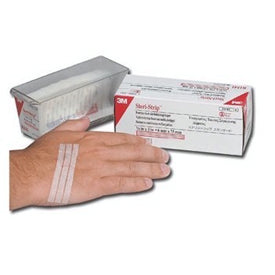

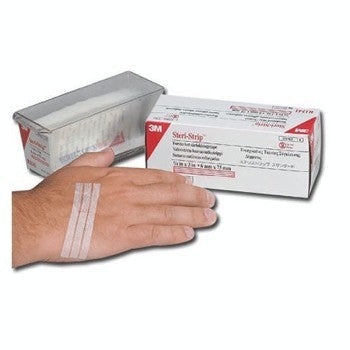

3M Steri-Strip Blend Tone Skin Closures
/


3M Steri-Strip Blend Tone Skin Closures
SKUs: B1551 (1/4"×3") | B1553 (1/4"×4") | B1557 (1/2"×4")
Light Beige Skin-Blending Color | Non-Reinforced | Microporous Non-Woven Backing | Hypoallergenic Adhesive | 3–5 Day Wear | FSA Eligible | Latex Free | By Solventum (Formerly 3M)
A non-reinforced adhesive skin closure strip in a light beige color designed to blend with skin tone and minimize visibility once applied. Shares the same microporous breathable non-woven backing and hypoallergenic pressure-sensitive adhesive as the standard reinforced Steri-Strip line — without the polyester filament layer. Appropriate for minor lacerations and incisions at lower tension levels where maximum tensile strength is not required and cosmetic discretion is a priority. Three-to-five day wear. By Solventum (formerly 3M). FSA eligible. Latex free.
Order by Part Number
| SKU | Dimensions | Strips per Envelope | Quantity Options |
|---|---|---|---|
| B1551 | 1/4" × 3" (6mm × 75mm) | 3 | Each | 50/Pack | 200/Case |
| B1553 | 1/4" × 4" (6mm × 100mm) | 10 | Each | 50/Pack |
| B1557 | 1/2" × 4" (12mm × 100mm) | 6 | Each | 50/Pack |
See the 3M Steri-Strip Reinforced (SKUs R1540–R1549) for higher-tension applications or longer wear requirements. Questions? 1-866-218-0902
Key Features
- Blend Tone light beige color — designed to match a range of skin tones and minimize visual contrast once applied; appropriate where strip visibility is undesirable, such as facial wounds or cosmetically sensitive sites
- Non-reinforced — no polyester filament layer; relies on non-woven backing strength alone; appropriate for minor lower-tension wounds
- Microporous non-woven backing — breathable; allows moisture vapor transmission to the wound surface; reduces risk of maceration
- Hypoallergenic pressure-sensitive adhesive — bonds to dry skin without sensitizing the surrounding area; suitable for most skin types including sensitive skin
- Flexible — moves with skin and adapts to body contours for a comfortable fit throughout wear
- 3–5 day recommended wear — shorter window than the reinforced line's 14-day capacity
- Water-resistant — can get wet; avoid excessive soaking
- Sterile packaging — each envelope sterile
- FSA eligible | Latex free
Contraindications
- Do not use where adequate adhesion cannot be obtained — exudate, skin oils, moisture, or hair prevent effective bonding
- Do not use on infected wounds
- Do not use on high-tension wounds that cannot be easily approximated with fingers or forceps — use the reinforced Steri-Strip or consider sutures/staples instead
Application and Removal
Application technique is identical to the reinforced Steri-Strip — clean and dry the skin, start at the wound midpoint, apply without tension, use sequential bisection to close the remaining wound, optionally add cross stays at each end. See the 3M Steri-Strip Reinforced page for the full step-by-step protocol.
For removal: gently loosen each end, then remove low and slow toward the wound, keeping the strip close to the skin surface and pulling it back over itself. Never remove at an upward angle — this pulls at the epidermis and increases mechanical trauma risk.
Clinical FAQs
What makes Blend Tone different from standard white Steri-Strips and when is the color distinction clinically relevant?
Standard Steri-Strip Reinforced closures (R-series) are white — clearly visible against most skin tones once applied. The Blend Tone closures use a light beige backing designed to approximate a neutral skin tone and reduce the visual contrast of the strip against the skin. For wounds on the face, neck, forearms, or other visible areas — particularly in patients for whom cosmetic outcome is a primary concern — the lower-visibility strip is meaningfully preferred. In emergency department or clinical settings where the strip is applied under clothing or in areas that will be covered, the color difference is irrelevant to the clinical outcome. The decision between standard and Blend Tone is based on wound location, patient preference, and the clinician's assessment of cosmetic priority.
How does non-reinforced differ from reinforced and which wounds are appropriate for each?
A reinforced Steri-Strip (R-series) embeds polyester filaments in the non-woven backing, substantially increasing tensile strength and resistance to tearing under repeated wound tension. The Blend Tone strips are non-reinforced — they rely on the non-woven backing alone. For minor, low-tension lacerations with easily approximated edges — typical small cuts and incisions in areas with minimal movement — the non-reinforced strip provides adequate closure strength within a 3–5 day wear window. For wounds under higher tension (near joints, in areas with edema, or on skin under repeated movement), or when a longer wear period is needed before the wound has sufficient tensile strength, the reinforced R-series is the appropriate choice. The contraindication for high-tension wounds on this page reflects this boundary: if the wound edges require noticeable force to bring together, neither closure type should be used without clinical assessment of whether sutures or staples are needed.
What are the post-removal skin changes warned about and how common are they?
The product literature notes two categories of post-removal skin changes. First, hypo- or hyperpigmentation — lightening or darkening of the skin at the strip application site following removal — can occur with any adhesive skin closure. This is a response to mechanical disruption of the superficial epidermis and is more common in patients with naturally reactive skin, darker skin tones prone to post-inflammatory hyperpigmentation, or in areas where the strip was worn for extended periods. The change is usually temporary and resolves with time, but patients with known pigmentation sensitivity should be counseled before application at cosmetically sensitive sites. Second, occasional cases of mild acne or folliculitis have been observed in clinical testing — a response to the occlusion of the skin surface by the strip backing, more likely in areas with higher follicular density. Both are uncommon and generally mild, but worth noting for informed patient consent at sensitive sites.
Questions about Blend Tone vs. reinforced Steri-Strip selection, or facial wound closure technique? Call our product specialists: 1-866-218-0902