


ConvaTec DuoDerm Extra Thin CGF Dressing — Vapor-Permeable, Translucent,
/


ConvaTec DuoDerm Extra Thin CGF Dressing — Vapor-Permeable, Translucent, 8 Sizes & Shapes
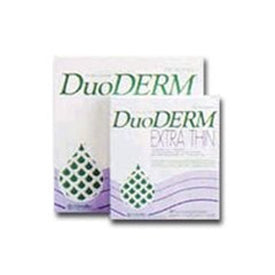
The thinnest DuoDerm. Vapor-permeable film. Translucent so you can see without changing. Eight sizes and shapes including spot, oval, and triangle. ConvaTec DuoDerm Extra Thin CGF is a sterile, self-adhesive hydrocolloid wound dressing built on the same proprietary ConvaTec Control Gel Formula (CGF) as the standard DuoDerm CGF line — but engineered in an ultra-thin, highly conformable profile with a vapor-permeable polyurethane film outer layer rather than a foam backing. This design makes the Extra Thin the right DuoDerm for a completely different wound category: dry-to-lightly exuding wounds, superficial wounds, skin tears, at-risk skin, and high-friction anatomical locations where a thicker dressing would add bulk, restrict movement, or fail to conform. The translucent film backing allows visual wound assessment without removing the dressing — preventing unnecessary dressing changes that disturb healing tissue. Available in eight sizes and shapes — including a 1¾" x 1½" spot, a 4" x 6" oval, and a 6" x 7" triangle — to cover every wound geometry and anatomical location in the Extra Thin use case.
✔ Ultra-Thin Profile — Conforms to High-Friction & Contoured Anatomy ✔ Vapor-Permeable Film Backing — Not Foam — For Dry-to-Light Exudate ✔ Translucent Backing — Visual Monitoring Without Dressing Change ✔ CGF Formula — Same Proprietary Hydrocolloid as Standard DuoDerm ✔ 8 Sizes & Shapes — Spot, Oval, Triangle & Square/Rectangle ✔ Latex-Free
Product Details & Available Sizes
| Manufacturer | ConvaTec |
|---|---|
| Dressing Type | Extra thin hydrocolloid — CGF (Control Gel Formula) |
| Outer Backing | Vapor-permeable polyurethane film — translucent; allows wound monitoring without removal |
| CGF Formula | Proprietary ConvaTec hydrocolloid — pectins, gelatins, CMC, elastomers |
| Exudate Level | Dry to lightly exuding wounds — also suitable for at-risk intact skin |
| Profile | Extra thin — highly conformable, low-bulk, low-friction profile |
| Wear Time | Up to 7 days — translucent backing allows assessment without removing |
| Use | Primary or secondary dressing |
| Sterility | Sterile |
| Latex | Not made with natural rubber latex |
| 187932 | Spot — 1¾" x 1½" — Box of 20 |
| 187900 | Rectangle — 2" x 4" — Box of 20 |
| 187961 | Rectangle — 2" x 8" — Box of 10 |
| 187901 | Square — 3" x 3" — Box of 20 |
| 187955 | Square — 4" x 4" — Box of 10 |
| 187957 | Square — 6" x 6" — Box of 10 |
| 187902 | Oval — 4" x 6" — Box of 10 |
| 187903 | Triangle — 6" x 7" — Box of 10 |
Indicated For — Wound Types & Skin Conditions
- Dry-to-lightly exuding dermal ulcers — venous, arterial, diabetic
- Superficial wounds — abrasions, minor lacerations, road rash
- Skin tears — fragile or elderly skin
- Post-operative wounds — light drainage surgical incisions
- Blisters — friction blisters, burn blisters (non-ruptured and ruptured)
- Early intervention — at-risk intact skin prone to breakdown under friction or pressure
- Stage I pressure injuries — erythema without skin break; prevention of progression
- Pressure ulcers (Stage II–IV) with dry or light exudate
- High-friction anatomical locations — heels, elbows, knees, ears, fingers, toes
- Eczema and dermatological conditions requiring a protective moist barrier
Contraindications: Not indicated for moderately-to-heavily exuding wounds — for wounds with significant drainage, use DuoDerm CGF or DuoDerm CGF Border instead. Not for third-degree burns, infected wounds without clinical management, or surgical implantation.
Extra Thin vs. CGF vs. CGF Border — Choosing the Right DuoDerm
ConvaTec's DuoDerm line uses the same proprietary CGF hydrocolloid formula across all three variants. The clinical difference between them is not the formula — it is the backing material, the exudate capacity that backing determines, and the secondary fixation method. Understanding these distinctions prevents the most common misapplication in DuoDerm selection: using the Extra Thin on a moderately draining wound, or using the standard CGF on a dry wound where the Extra Thin's thinner profile would be more appropriate and comfortable.
- DuoDerm Extra Thin (this product): Vapor-permeable polyurethane film backing. Translucent. Ultra-thin, highly conformable. For dry to lightly exuding wounds, at-risk intact skin, skin tears, and high-friction locations where a thicker dressing would add bulk or restrict movement. Eight shapes including spot, oval, and triangle. Self-adhesive — no tape or border required for most applications.
- DuoDerm CGF (non-bordered): Opaque, thicker hydrocolloid pad construction. For partial and full-thickness wounds with light to moderate exudate. Higher absorption capacity than Extra Thin. Requires tape or secondary dressing for fixation.
- DuoDerm CGF Border: Same thicker hydrocolloid pad as CGF, with a wide polyurethane foam adhesive border that eliminates tape entirely. For light-to-moderate exudate wounds in hard-to-dress areas where tape-free, border-secured fixation is needed. Available in triangle shapes optimized for sacral and heel anatomy.
The decision rule is simple: dry or light drainage + friction/contour challenge = Extra Thin; light to moderate drainage + standard wound = CGF; light to moderate drainage + hard-to-dress location = CGF Border.
The Vapor-Permeable Film — What It Does That Foam Backing Doesn't
The standard DuoDerm CGF and CGF Border use a polyurethane foam outer layer — opaque, thicker, and highly occlusive. The Extra Thin uses a vapor-permeable polyurethane film instead. This is not simply a thinner version of the same backing — it is a fundamentally different material with distinct functional properties.
Vapor-permeable film allows water vapor (but not liquid water or bacteria) to pass through the backing in both directions. This means the wound environment under the dressing can exchange moisture vapor with the external environment, preventing excessive moisture buildup that can macerate periwound skin — a risk that is amplified on very low-drainage wounds where even small amounts of vapor accumulation can saturate the interface. For dry wounds and at-risk intact skin, this vapor transmission is critical: the dressing maintains a gently moist environment that supports healing without creating the hypersaturated conditions that standard occlusive hydrocolloid dressings can produce on minimally exuding sites.
The film backing is also the reason for the Extra Thin's translucency. Unlike the opaque foam layer of the standard CGF, the polyurethane film is visually transparent enough to allow the wound or skin beneath to be assessed without removing the dressing. This is particularly valuable for at-risk skin monitoring — a caregiver can check the color of the skin under the dressing during daily care without disturbing the dressing seal or the healing environment beneath it. Unnecessary dressing removals are one of the most underappreciated sources of wound healing disruption and patient discomfort; translucency directly reduces their frequency.
- Vapor-permeable — allows water vapor exchange, prevents maceration on dry and minimally draining wounds
- Translucent — wound and skin visible through the backing without dressing removal
- Prevents unnecessary dressing changes — visual assessment without disturbing the wound environment
- Waterproof to liquid water — repels external moisture despite vapor permeability
- Ultra-thin profile — significantly lower bulk than foam-backed variants, less noticeable under clothing
- Highly conformable — follows body contours at joints, heels, ears, toes, and fingers without wrinkling or lifting
- Low friction — smooth film surface reduces shear force against clothing and bedding on high-friction sites
The Spot Size — Extra Thin 187932
The 1¾" x 1½" Spot (187932) is the smallest dressing in the DuoDerm line and is specifically designed for a use case that no other size in the line addresses: single blister protection, small pressure injury prevention on bony prominences, individual toe and finger wounds, IV puncture site protection, and any site where a larger dressing would cover and irritate healthy skin unnecessarily. The compact footprint also makes the spot the most practical choice for acne patch applications — the CGF hydrocolloid's ability to absorb superficial wound exudate while maintaining a moist occlusive environment is equally effective on inflammatory skin lesions as on dermal wounds. The 20-per-box count at this size makes it economical for high-frequency use.
Choosing the Right Size & Shape
- 187932 — Spot 1¾" x 1½": Single blisters, small friction wounds, individual digit wounds, puncture sites, acne patches, and any wound where the smallest possible dressing footprint is needed
- 187900 — Rectangle 2" x 4": Elongated small wounds — short surgical incisions, toe wounds, finger wounds, narrow abrasions, and any wound that runs longer than a square spot but doesn't need full pad width
- 187961 — Rectangle 2" x 8": Extended narrow wounds — longer incisions, shin abrasions, tibial wounds, saphenous vein harvest sites, and any elongated wound on a narrow surface
- 187901 — Square 3" x 3": Small-to-medium wounds — small Stage I–II pressure injuries, compact skin tears, small post-operative wounds, and locations where the 4x4 would overhang onto normal skin
- 187955 — Square 4" x 4": Standard size — the most commonly used Extra Thin; typical pressure injuries, standard skin tears, moderate-size superficial wounds, and post-operative sites of average dimension
- 187957 — Square 6" x 6": Larger wound coverage — extensive skin tears, large superficial abrasions, broad pressure injury surfaces, and large at-risk skin areas requiring protective coverage
- 187902 — Oval 4" x 6": Oval-shaped wounds or anatomically rounded sites — posterior heel, elbow tip, knee cap, and any wound on a rounded surface where the oval conforms better than a square and avoids corners that lift early
- 187903 — Triangle 6" x 7": Sacral and contoured large wounds — same anatomical rationale as the CGF Border triangle; the triangular shape follows sacral and heel contours for better edge seal and extended wear time on these high-risk sites
Not sure which size fits your wound? Call 1-866-218-0902 — Mon–Fri, 9am–5pm EST
Why Buy From Medical Department Store?
- 30+ years serving home medical and wound care customers — A+ BBB Rated
- 110% Low Price Guarantee — we beat any competitor
- Medical supply specialists on the phone, not a call center
- Ships to all 50 states — 5 Southwest Florida locations for local pickup
Questions about DuoDerm Extra Thin or any of our hydrocolloid wound dressings? Call 1-866-218-0902 — our team is ready to help.